
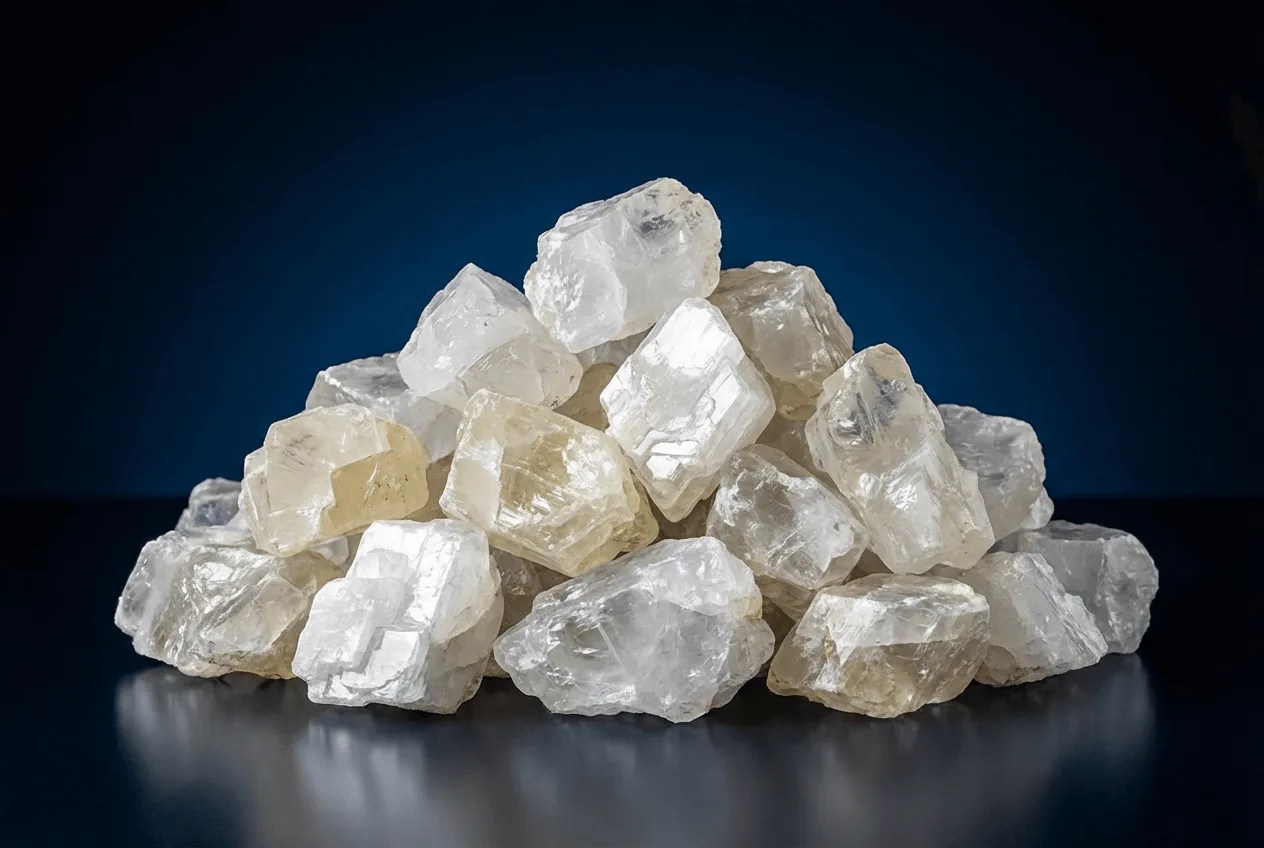
Barite: The Essential High-Density Mineral
Barite (or Baryte) is the common name for the mineral form of Barium Sulfate (BaSO4). This mineral is characterized by its unusually high specific gravity (density), typically ranging from 4.2 to 4.5 g/cm³, which is significantly higher than most other non-metallic minerals. Chemically inert and soft (2.5–3.5 on the Mohs scale), Barite is non-toxic and opaque to X-rays.
Barite occurs in various geological settings, including lead-zinc veins, limestone, and hot spring deposits. The color can range from white to gray to light yellow. Globally, Barite is a critical industrial mineral, with its value determined by its purity, color, and, most importantly, its high specific gravity (SG).
ERST Group supplies various grades of Barite, conforming to strict API (American Petroleum Institute) standards for drilling applications.
Key Characteristics and Applications
The unique combination of high density, chemical inertness, and softness makes Barite indispensable in the energy sector.
Key Characteristics
- High Specific Gravity (SG): This is the most crucial characteristic, making it an excellent weighting agent.
- Chemical Inertness: It does not react with acids, bases, or other drilling fluids, maintaining stability in downhole conditions.
- Softness: Its low hardness prevents abrasion to expensive drilling equipment.
- Non-Toxic: Safe for use in industrial applications and the environment compared to some other dense materials.
Primary Application: Drilling Mud
The overwhelming majority (over 90%) of Barite consumed globally is used in the Oil and Gas Industry as a weighting agent in drilling fluids, commonly referred to as drilling mud.
- Pressure Control: The added density of the Barite-laden mud creates hydrostatic pressure in the wellbore, which counteracts the high pressures of oil, gas, and water formations encountered during drilling. This prevents catastrophic blowouts and stabilizes the wellbore.
Secondary Applications
- Medical: Used as a barium meal (contrast agent) for X-ray imaging of the digestive system.
- Fillers: Used as a high-density filler in paints, plastics, brake linings, and rubber products.
- Sound Dampening: Employed in heavy concrete aggregates for radiation shielding in hospitals and nuclear facilities.
Standard Specifications (API 13A - Drilling Grade)
Barite used in drilling mud must meet strict physical and chemical requirements set by the American Petroleum Institute (API) to ensure optimal downhole performance.
Barite Specification (API Standard Grade)
| Property | Specification | Rationale for Requirement |
|---|---|---|
| Specific Gravity (SG) | Min 4.20 g/cm³ | Essential for generating sufficient hydrostatic pressure in the wellbore. |
| Barium Sulfate (BaSO4) | Min 92.0 % | Defines the purity and quality of the weighting agent. |
| Water Soluble Alkaline Earth Metals (Ca) | Max 250 mg/kg | Limits the presence of soluble ions (like Calcium) that could flocculate the drilling fluid. |
| Residue greater than 75 µm (200 Mesh) | Max 3.0 % | Ensures fine particle size to prevent clogging of formation pores and equipment. |
| Particle Size Distribution | Must be fine enough to remain in suspension in the mud. | Prevents settling (sagging) of the weighting material in the wellbore. |
Forms and Packaging
Barite is processed into a fine, uniform powder to ensure it mixes smoothly with drilling fluids and remains in suspension.
- Forms: Supplied as crude Barite ore (lumps) or, most commonly, as a finely ground powder (micronized).
- Packaging: Typically packaged in heavy-duty, moisture-resistant 1.5 Metric Tonne Jumbo Bags (Big Bags) or in smaller 50 kg multi-ply paper sacks, depending on the client’s logistical needs.