
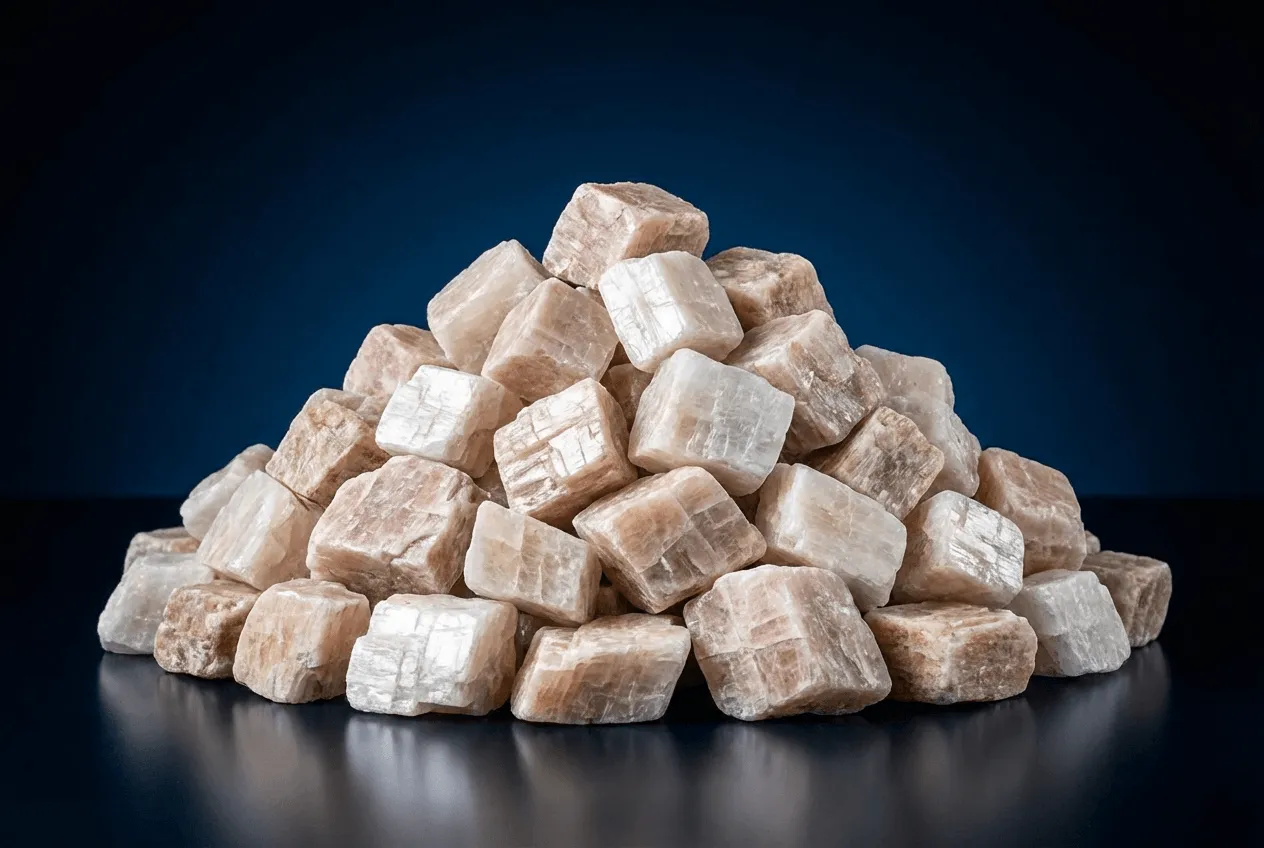
Feldspar: The Essential Fluxing Agent for Ceramics and Glass
Feldspar is the name given to a large group of rock-forming tectosilicate minerals that make up over 50% of the Earth’s crust by weight. Chemically, feldspars are aluminum silicates containing varying amounts of Potassium (K), Sodium (Na), and Calcium (Ca). The two main types exploited commercially are Potassium Feldspar (K-spar, e.g., orthoclase, microcline – KAlSi3O8) and Sodium Feldspar (Na-spar, e.g., albite – NaAlSi3O8).
Feldspar is valued industrially not for its chemical formula, but for its role as a fluxing agent. When heated, feldspar melts gradually at a relatively low temperature, allowing for the slow melting of the surrounding materials (like quartz and clay), thus improving the body’s strength, durability, and chemical resistance.
ERST Group supplies high-quality, ground Feldspar powder, tailored to the specific chemical and physical requirements of the glass and ceramic industries.
Barite occurs in various geological settings, including lead-zinc veins, limestone, and hot spring deposits. The color can range from white to gray to light yellow. Globally, Barite is a critical industrial mineral, with its value determined by its purity, color, and, most importantly, its high specific gravity (SG).
ERST Group supplies various grades of Barite, conforming to strict API (American Petroleum Institute) standards for drilling applications.
Key Characteristics and Applications
Feldspar’s primary industrial value lies in its high alumina content (providing stability) and its alkali content (providing the fluxing action).
Key Characteristics
- Fluxing Action: The presence of K2O and Na2O lowers the melting point of the ceramic or glass batch, reducing energy costs and aiding vitrification (glassy transformation).
- Alumina (Al2O3) Source: Provides mechanical strength and chemical durability to the finished product.
- Non-Toxic: Safe for use in products like dinnerware and food containers.
- Abundance: It is one of the most common minerals on Earth, ensuring a stable supply chain.
Primary Application
- Glass Manufacturing (60%): Used as a primary source of Al2O3 and Na2O / K2O to prevent devitrification (crystal formation) in glass melts, enhancing glass durability, scratch resistance, and clarity.
- Ceramics and Tiles (35%): Employed in glazes and ceramic bodies (e.g., porcelain, sanitaryware, wall/floor tiles) to act as a flux, enabling the formation of a smooth, vitreous phase that bonds the other components together.
- Filler: Used as a functional filler in paints, plastics, and adhesives, where it can improve durability and resistance to abrasion.
- Welding Electrodes: Utilized as a flux component in the coating of welding electrodes.
Standard Chemical Specifications
Feldspar quality is primarily determined by its alkali content and, critically, the level of iron oxide (Fe2O3), as iron causes discoloration in white ceramics and glass.
Standard Feldspar Specification (Ceramic/Glass Grade)
| Element/Property | Typical Specification (%) | Rationale for Requirement |
|---|---|---|
| Silicon Dioxide (SiO2) | 65.0 – 75.0 % | Main component; structural silica source. |
| Aluminum Oxide (Al2O3) | 17.0 – 21.0 % | Provides final product hardness and chemical stability. |
| Potassium Oxide (K2O) + Sodium Oxide (Na2O) | 8.0 – 14.0 % | **Crucial Fluxing Agents;** lowers the firing temperature. |
| Iron Oxide (Fe2O3) | Max 0.10 % | **Critical Impurity;** must be minimized to avoid color defects (green/brown tint) in white glass/ceramics. |
| Loss on Ignition (LOI) | Max 0.5 % | Indicates minimal presence of moisture or carbonates. |
| Moisture | Max 0.2 % | Required for smooth, consistent mixing and handling. |
Forms and Packaging
Feldspar must be supplied in a consistent, fine powder form to ensure uniform mixing and melting within the industrial batch.
- Forms: Supplied as crude ore (lumps) or, most commonly, as a finely ground powder (typically $200$ Mesh or finer).
- Packaging: Due to high volume usage, it is often shipped in 1.5 Metric Tonne Jumbo Bags (Big Bags) or in bulk via containers, with the packaging ensuring moisture exclusion for quality preservation.