
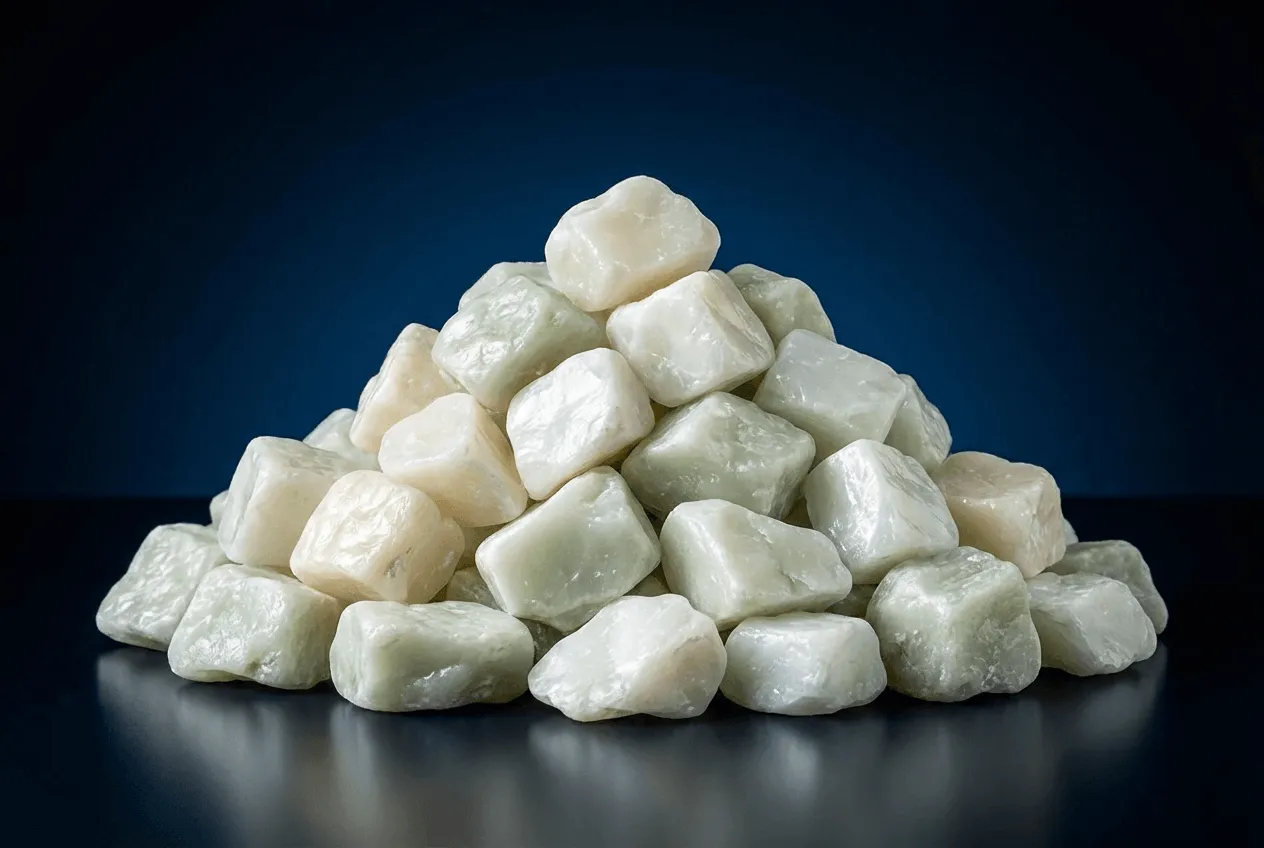
Talc: The Softest Mineral and Industrial Filler
Talc is a mineral composed of hydrated magnesium silicate (Mg3Si4O10(OH)2). It is renowned as the softest mineral on the Mohs scale of hardness (ranking 1). Talc is characterized by its perfect cleavage, resulting in thin, plate-like particles that give it unique properties such as extreme softness, excellent lubricity (slippery feel), chemical inertness, high whiteness, and thermal stability.
Commercially, Talc is mined, crushed, and ground into fine powders, often purified to meet specific industrial requirements regarding color, particle size, and purity (especially low asbestos/fibrous content). Talc grades are often referred to as talcum powder.
ERST Group supplies various grades of industrial Talc, tailored for use in sectors like plastics, ceramics, paper, and cosmetics.
Feldspar is valued industrially not for its chemical formula, but for its role as a fluxing agent. When heated, feldspar melts gradually at a relatively low temperature, allowing for the slow melting of the surrounding materials (like quartz and clay), thus improving the body’s strength, durability, and chemical resistance.
ERST Group supplies high-quality, ground Feldspar powder, tailored to the specific chemical and physical requirements of the glass and ceramic industries.
Barite occurs in various geological settings, including lead-zinc veins, limestone, and hot spring deposits. The color can range from white to gray to light yellow. Globally, Barite is a critical industrial mineral, with its value determined by its purity, color, and, most importantly, its high specific gravity (SG).
ERST Group supplies various grades of Barite, conforming to strict API (American Petroleum Institute) standards for drilling applications.
Key Characteristics and Applications
Talc’s unique lamellar structure and softness are key to its wide range of industrial applications.
Key Characteristics
- Extreme Softness (Mohs 1): Minimizes wear on machinery during processing.
- Lubricity and Slip: The plate-like structure slides easily, making it an excellent anti-stick agent, lubricant, and body powder.
- Chemical Inertness: Non-reactive with most acids and bases; resistant to heat and electricity.
- Organophilicity: Possesses a natural affinity for organic chemicals, making it a good filler for polymers and paints.
- High Aspect Ratio (Platelets): Provides excellent dimensional stability, stiffness (modulus), and anti-sag properties in paints and plastics.
Primary Application
- Plastics: Used as a reinforcing filler to increase stiffness, dimensional stability, and heat resistance in polyolefins (PP, PE), particularly in automotive parts and appliance casings.
- Paper: Used as a pitch control agent, a filler to improve smoothness and opacity, and a coating pigment.
- Paints and Coatings: Acts as an extender and functional filler to prevent settling, improve paint opacity, and enhance weather resistance and corrosion protection.
- Ceramics: Improves the firing characteristics and reduces thermal expansion in sanitaryware, tiles, and electrical insulators.
- Cosmetics and Pharmaceuticals: Used as a base powder due to its softness and moisture-absorbing properties (must be certified asbestos-free).
Standard Specifications (Industrial Grade)
The specification of Talc varies significantly depending on the application, but high whiteness, controlled particle size, and chemical purity are universally important.
Standard Industrial Talc Specification
| Property | Typical Specification | Significance in Application |
|---|---|---|
| Purity (Mg3Si4O10(OH)2) | Min 90.0 % | Defines quality; low levels of impurities like Dolomite or Calcite. |
| Whiteness ($L$)* | Min 85.0 % | Critical for cosmetic, paper, and high-quality paint fillers. |
| Moisture | Max 0.5 % | Required for good flowability and consistent weight. |
| Residue on 325 Mesh (45 µm) | Max 0.5 % | Particle size control is crucial for smoothness and compatibility in coatings/polymers. |
| Iron Oxide (Fe2O3) | Max 0.5 % | Must be low to maintain high whiteness and purity. |
| Brightness (ISO R457) | Min 75 % | Metric for color quality, important for optical performance. |
Forms and Packaging
Talc is supplied as a fine powder, often micronized to achieve sub-micron particle sizes for specialized applications like plastics and paint reinforcement.
- Forms: Supplied as crude Talc (lumps) or, predominantly, as finely ground, processed powder.
- Packaging: Typically packaged in 25 kg paper bags or large, durable 1.0 Metric Tonne Jumbo Bags (Big Bags), ensuring protection against moisture and contamination. Cosmetic and pharmaceutical grades require specialized, certified packaging.